Should La Jolla Cove close to protect sea lions? San Diego faces mounting pressure
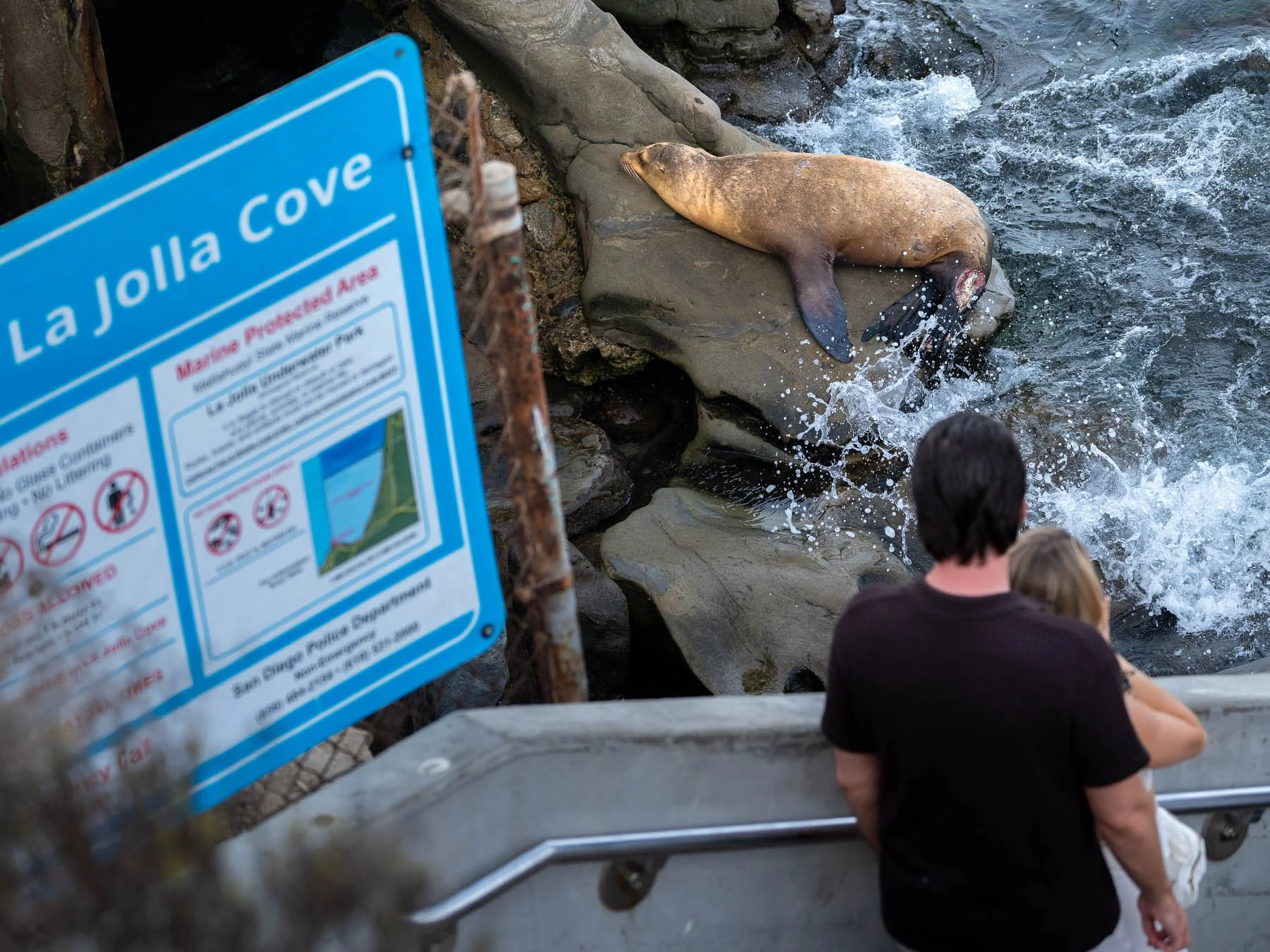
A father and daughter look at an injured sea lion from the western staircase at La Jolla Cove, a massively popular beach for its small size and close proximity to wildlife.
At La Jolla Cove, anyone who steps too close to a sea lion may be met by a megaphone-wielding park ranger and, at times, jeering onlookers — part of the city’s balancing act between protecting wildlife and maintaining public access to the iconic beach.
Striking the right balance has proved difficult. Despite increased park ranger presence and public education campaigns, people continue to approach, touch and harass the animals.
The balancing act became even more evident after a late-night viral video taken on July 22 showed a man repeatedly kicking a sea lion at Point La Jolla — near La Jolla Cove.
Tyler Muehl, an 18-year-old La Jolla resident, pled guilty in federal court on August 13 to violating the Marine Mammal Protection Act.
While his admission resolved the case, it left San Diego officials debating how best to protect sea lions at La Jolla Cove while preserving public access to one of San Diego’s top tourist attractions.
At the same time, advocacy groups are pushing for immediate action.
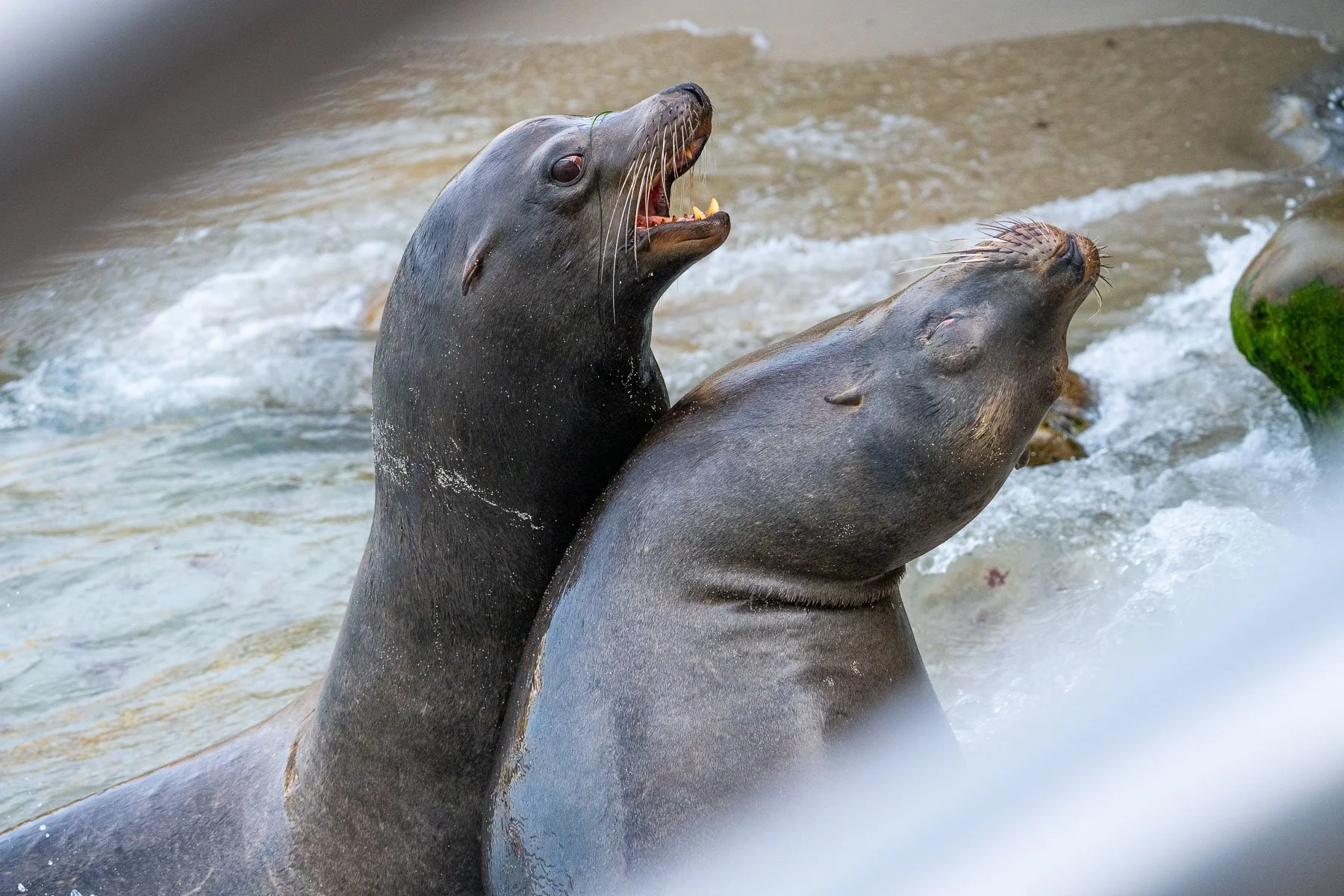
At La Jolla Cove, visitors stand just a few steps away from two California sea lions roughhousing as the tide rolls over the sand. “Please don’t fight!” screams a small child watching the duel between the metal railings of the beach access stairs.
The Seal Society of San Diego, a volunteer program that educates the public to promote safe viewing of local harbor seals and sea lions, is calling on the city to protect the pinnipeds at La Jolla Cove and the Children’s Pool.
At the same time, more than 21,000 people have signed a Change.org petition calling on the city to close Children’s Pool to the public.
State and federal agencies are also chiming in, conversing with city leaders about possible solutions.
The debate has also drawn the attention of state and federal agencies. The Coastal Commission and the National Oceanic and Atmospheric Administration (NOAA) are discussing with city officials what additional measures could protect the sea lions, with beach closure viewed by many as a last resort.
Coastal commissioner Matt O’Malley, San Diego’s representative on the commission, expressed his frustration with the city at the state agency’s meeting on August 14, the day after Muehl’s guilty plea.
“I’m at the point where I believe a partial closure is the only way to deal with this issue until the city gets their program implementation figured out and investigates what is going on here,” O’Malley said. “I’m sorry to have to be an advocate for that at this point.”
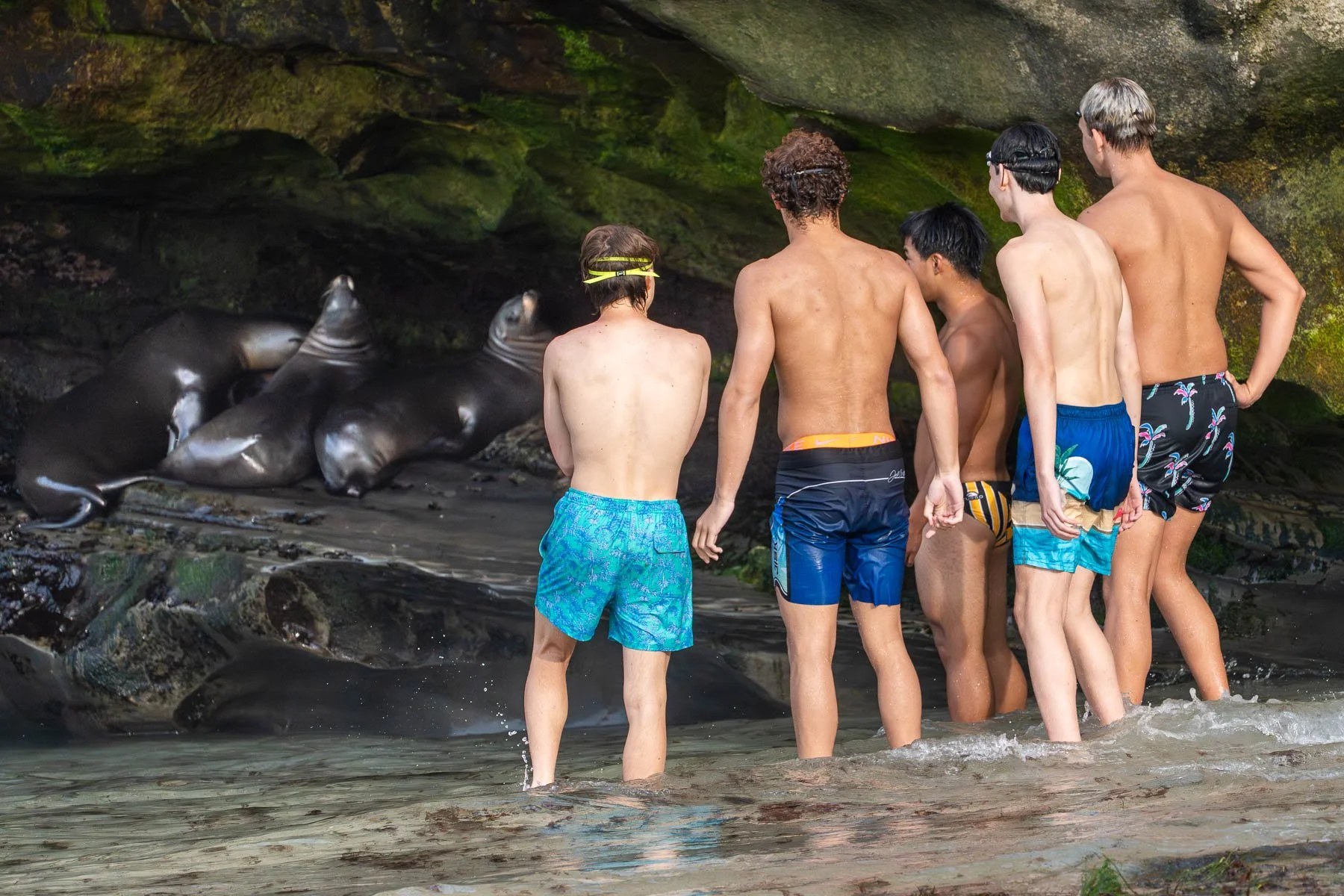
Five teenage swimmers appear to violate the Marine Mammal Protection Act by approaching sea lions nestled within the eastern cliffs at La Jolla Cove. Federal law requires beachgoers to stay at least 150 feet away from protected wildlife. Violators risk fines up over $36,000 and up to 1 year in prison.
O’Malley said the city has failed to do enough to protect marine life. “I’m left to conclude that where there is a will, there is a way, and I can only conclude there is no will on behalf of the city to protect the wildlife in this area,” O’Malley said.
City Council President Joe LaCava, a longtime La Jolla resident, disagrees with O’Malley. LaCava says he and city officials have worked to increase ranger presence during peak tourism periods, install new signage and educate visitors by coordinating with volunteers and private tour companies.
LaCava and the city oppose closing La Jolla Cove, believing it is not right to broadly eliminate public access because of individual unlawful actions.
Visitors who ignore warnings to keep their distance are entering the territory of animals that weigh hundreds of pounds — the biggest is Big Hank the “Tank,” La Jolla Cove’s dominant male sea lion, who weighs up to 1,000 pounds.
The 140-foot shoreline is home to Hank and other sea lions that regularly sit, swim and play right next to beachgoers.
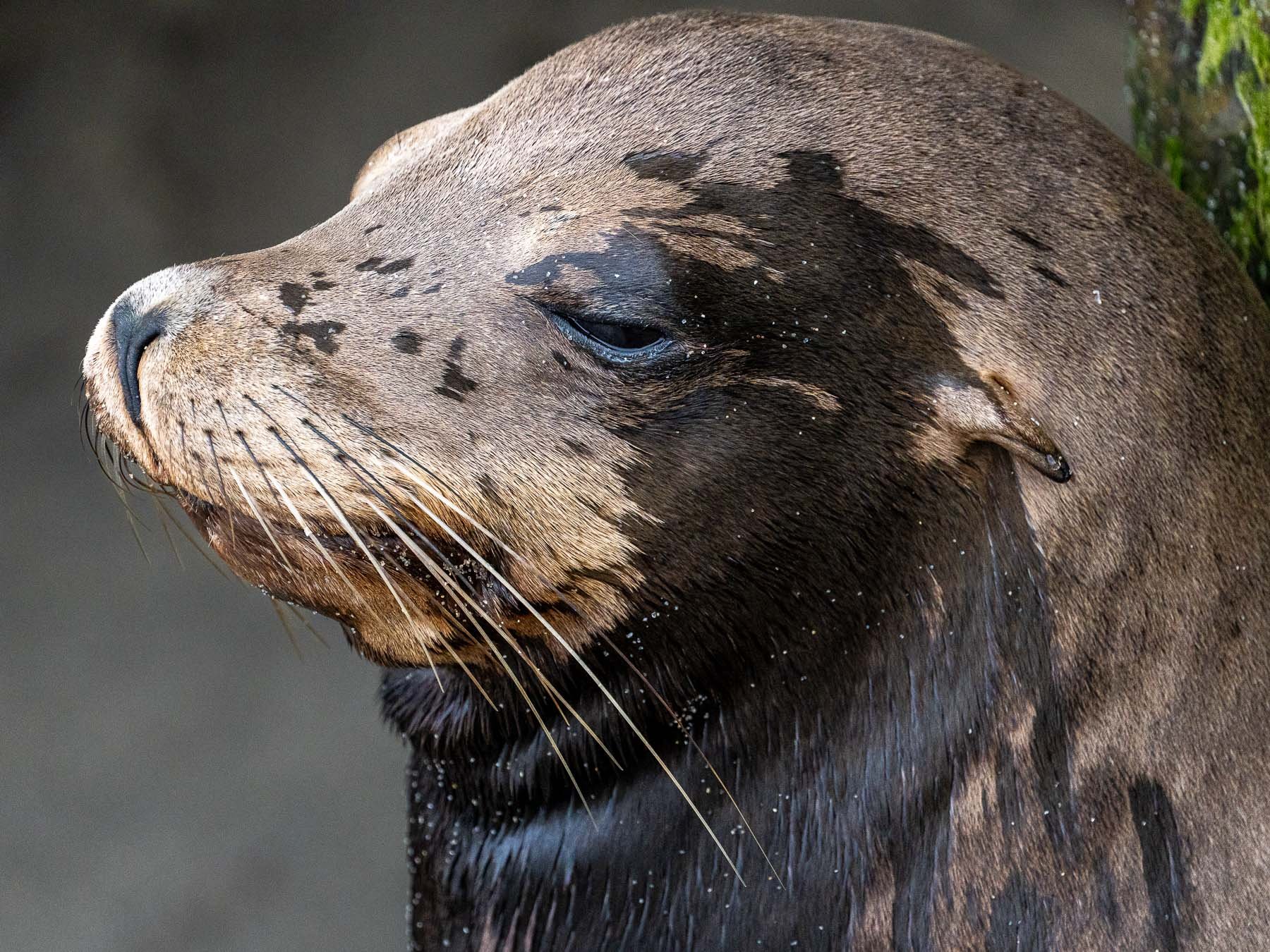
A California sea lion rests beside algae-covered sandstone cliffs after playing in the water at La Jolla Cove. Sea lions can be identified by their visible ears, which harbor seals lack — instead, they have small ear holes.
Who can actually enforce the law?
The sea lions are federally protected, and violations of the Marine Mammal Protection Act are federally enforced by the National Marine Fisheries Service, NOAA’s habitat protection division, not the city of San Diego. The agency urges witnesses to report suspected violations to investigators.
But federal enforcement does not mean there is no role for the city.
Park rangers have increased their presence during tourism peaks, while volunteers and tour guides have been enlisted to educate visitors. And yet, people continue to approach the animals to take selfies, throw sand or rocks, pet them and otherwise disturb them.
“Maintaining public access does not mean taking a passive approach to protecting wildlife,” a city spokesperson told Times of San Diego. “When rangers observe concerning interactions with marine wildlife, they can document those incidents and provide that information to NOAA Enforcement for investigation.”
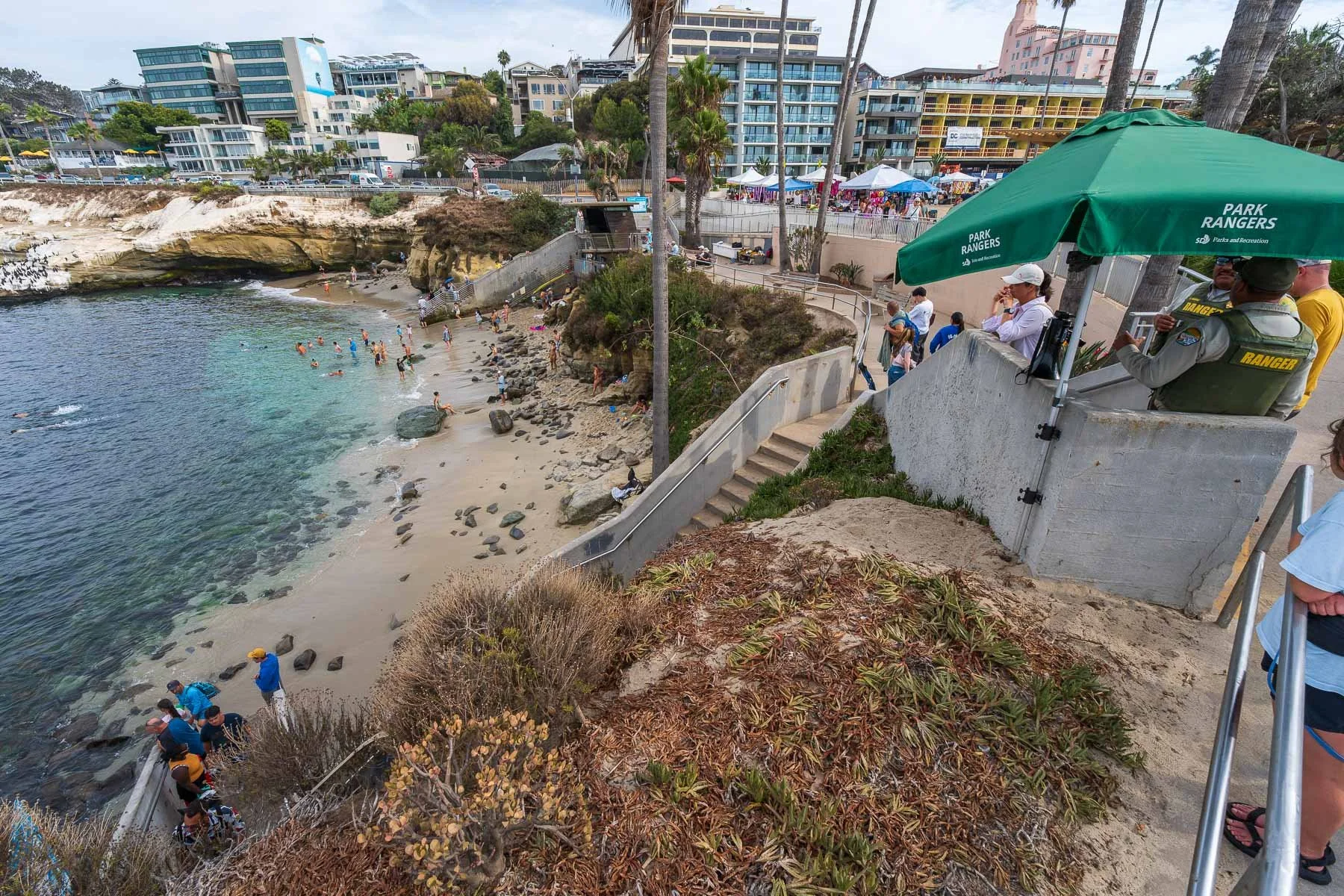
Two park rangers equipped with megaphones watch over La Jolla Cove on August 20, 2026.
San Diego has closed coastal areas to protect marine mammals
Rugged, ancient sea cliffs break up La Jolla’s seven-mile coastline into six iconic sections, two of which already have public access restrictions.
Point La Jolla is closed year-round to protect the sea lions sprawled across the slippery sandstone outcropping. A short walk southwest on Coast Boulevard brings visitors to Children’s Pool, which is closed during harbor seal pupping season from December to May.
But LaCava said Point La Jolla is not necessarily a model for closing the Cove.
“Point La Jolla itself is just a rocky outcrop. Nobody sees that, and the Commission didn’t see that as a coastal access issue,” LaCava said. “People really shouldn’t be walking out there anyway.”
The distinction matters. Point La Jolla is an algae-slicked sandstone shelf where sea lions like to lounge, while the Cove is a popular and heavily used public swimming beach.
Closing the Cove would therefore raise a much larger coastal-access question.
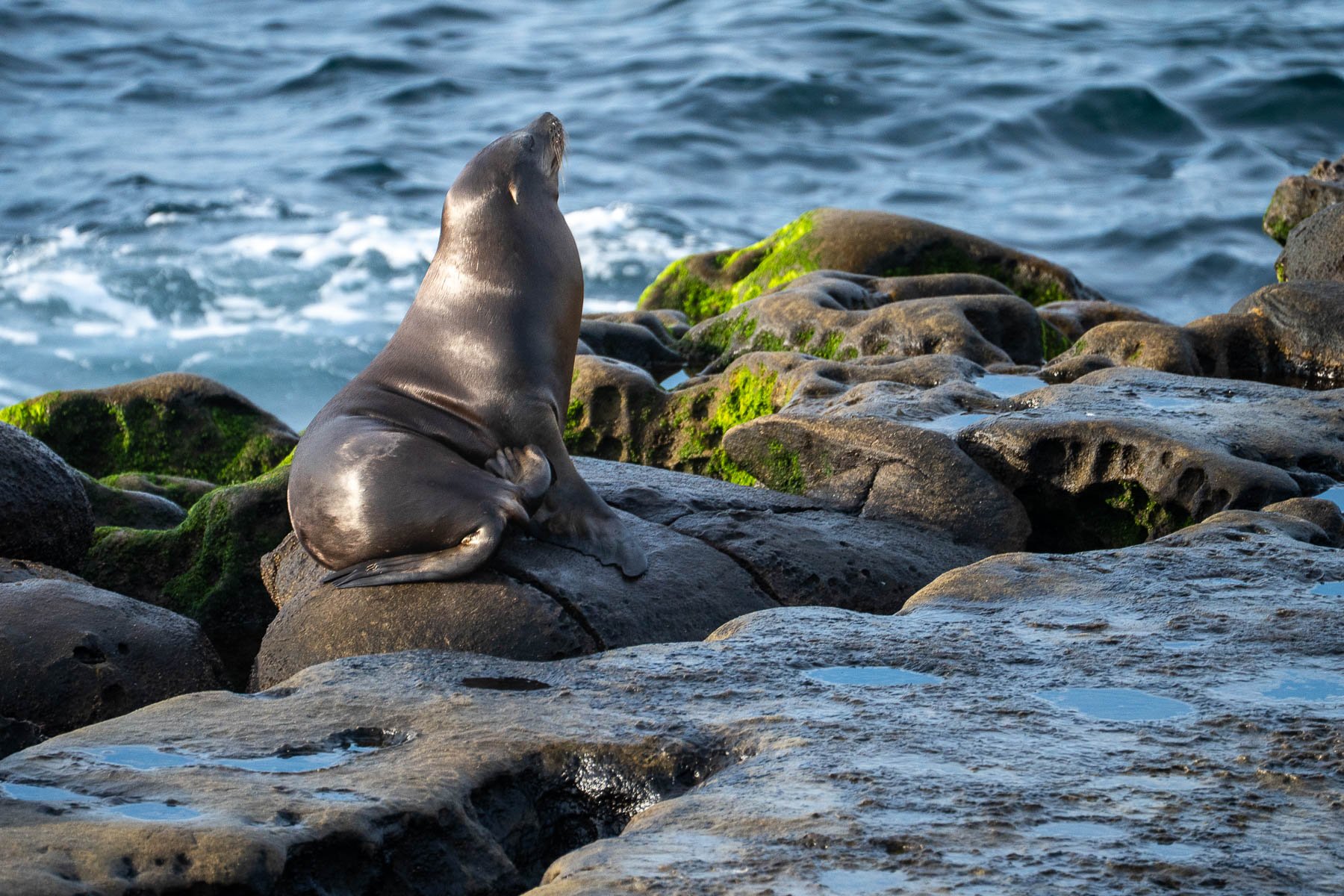
A sea lion sitting on the slick sandstone of Point La Jolla. The area is closed to the public year-round to protect wildlife and visitors.
Robyn Davidoff, who has chaired the Sierra Club Seal Society for seven years, remembers the fight to temporarily close the Children’s Pool as a years-long, grueling effort. “I joined, and everyone in the group was moving on. They said, ‘Look, we did the Children’s Pool. It was very nasty and took a lot of years,’” Davidoff said.
With Davidoff at the helm, the group later began advocating for the sea lions at Point La Jolla.
“In 2021, we got a six-week closure for Point La Jolla. In 2023, we got year-round closure,” Davidoff said.
The history shows that wildlife closures require coordination among the city, Coastal Commission, wildlife agencies and community groups while accounting for California’s coastal-access requirements. In short, it’s not an easy change.
Why is protection needed?
Sea lion pups are particularly vulnerable during pupping season from May to October, according to the city, which warns that human interaction with newborns can lead to abandonment and injury.
The Seal Society estimates that 43% of pups have died so far this year, compared with more than half in each of the previous two years. Mortality at the closed Point La Jolla site is estimated to be 6%.
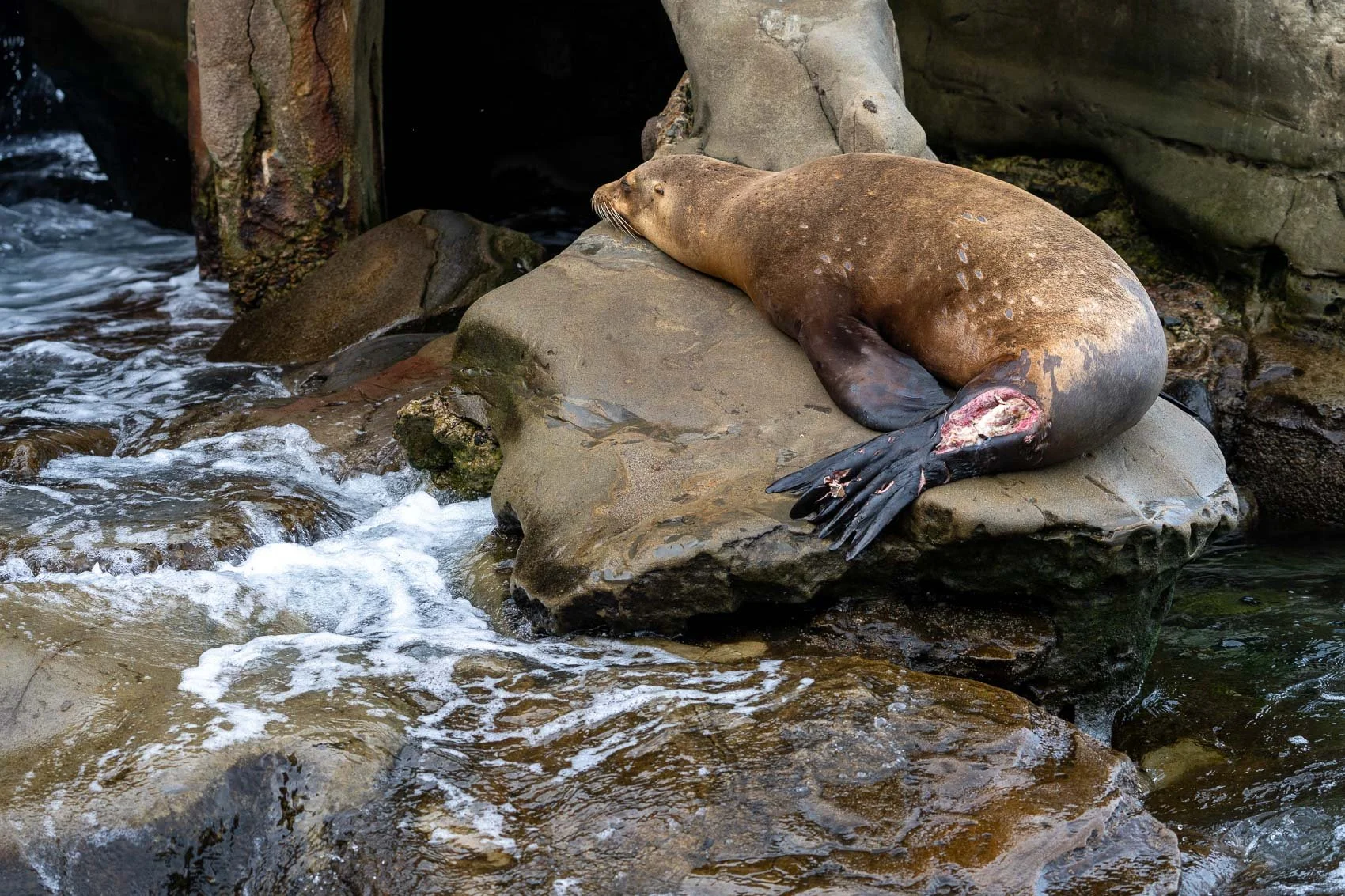
An injured sea lion lies next to the western cave at La Jolla Cove, near a beach access stairway, on August 20, 2026. Park rangers present did not know how it sustained the injury. Times of San Diego observed dozens of visitors walk down the stairs to take photos of the wounded animal.
For Davidoff, education alone isn’t enough. Visitors cycle through the small beach constantly, and rangers cannot be there to warn every person who approaches the animals.
“It’s very difficult to deal with millions of tourists a year on a very small beach. People come and go every ten minutes or so to see the sea lions, and so they may not have heard the message,” she said.
Davidoff said the city needs a visible physical boundary around the animals.
“We can’t allow this kind of lawlessness to happen, like the Wild West. Our suggestion has been, for years now, to place cones and tape on the beach near the sea lion pups so that they cannot be disturbed.”
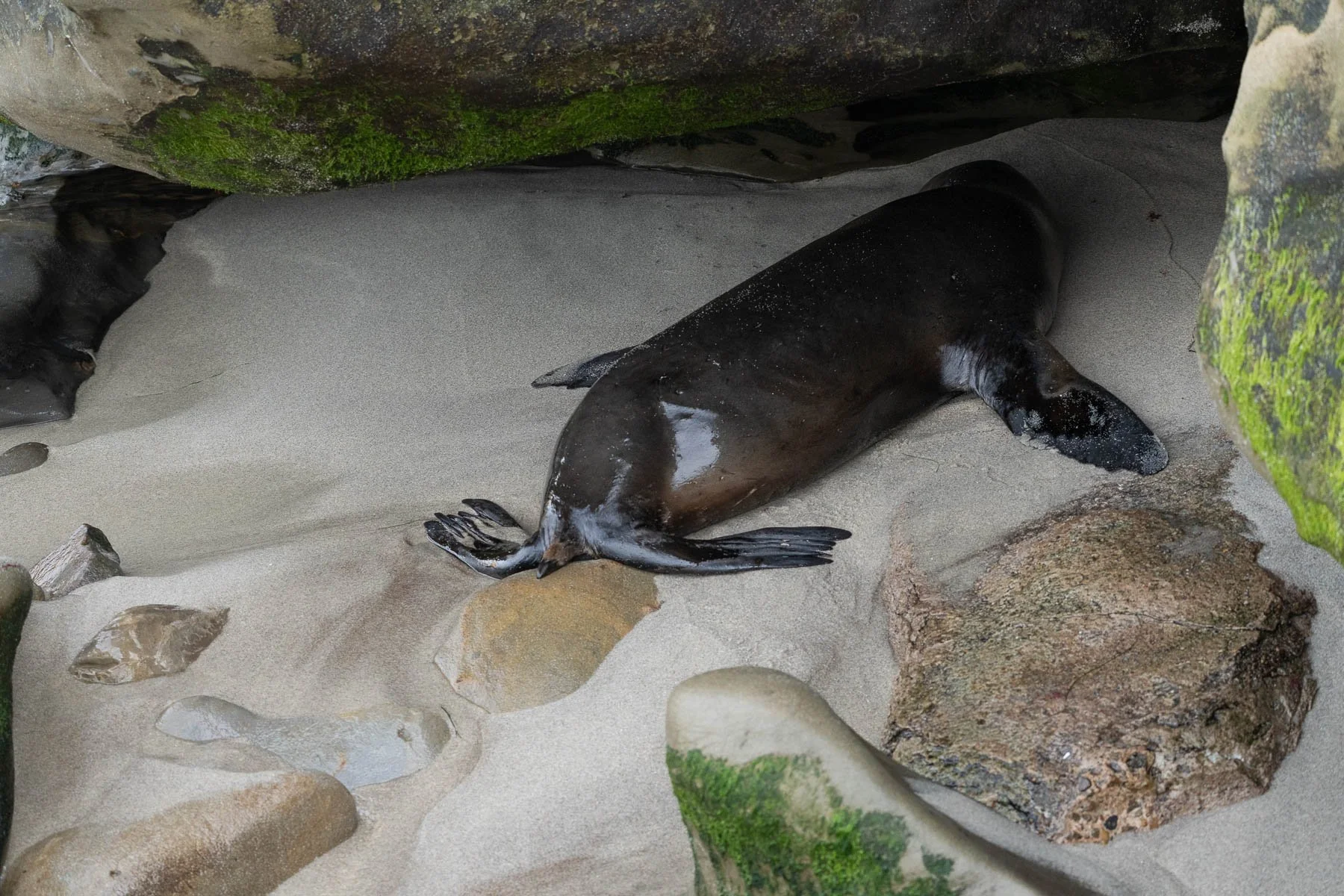
A young California sea lion attempts to hide from La Jolla Cove visitors in the shadow of the algae-covered sandstone cliffs that wall off the 140-foot beach.
What comes between a warning and federal prosecution?
LaCava remains opposed to closing the Cove, but acknowledges that the city’s current approach has limitations. The city has already made enforcement more visible, adding a park ranger at the Cove after previously concentrating rangers at Point La Jolla.
The problem, then, is not a lack of enforcement presence. It is what those rangers can do once they see a violation.
LaCava said officials are considering a middle ground between verbal warnings from city employees and federal prosecution.
“Yelling at people apparently is not enough, even with the megaphone,” LaCava said. “How can we give our park rangers some kind of civil citation?”
Federal law provides a mechanism to designate state officers to enforce the Marine Mammal Protection Act, but makes no mention of city employees having the authority to enforce the federal law. Whether that authority could be extended to San Diego park rangers — and what form such enforcement would take — remains a question for NOAA and the city.
Until that occurs, park rangers will enforce city law, issue warnings with megaphones and document violations for federal investigators whenever people disturb or harass La Jolla pinnipeds or other marine life.
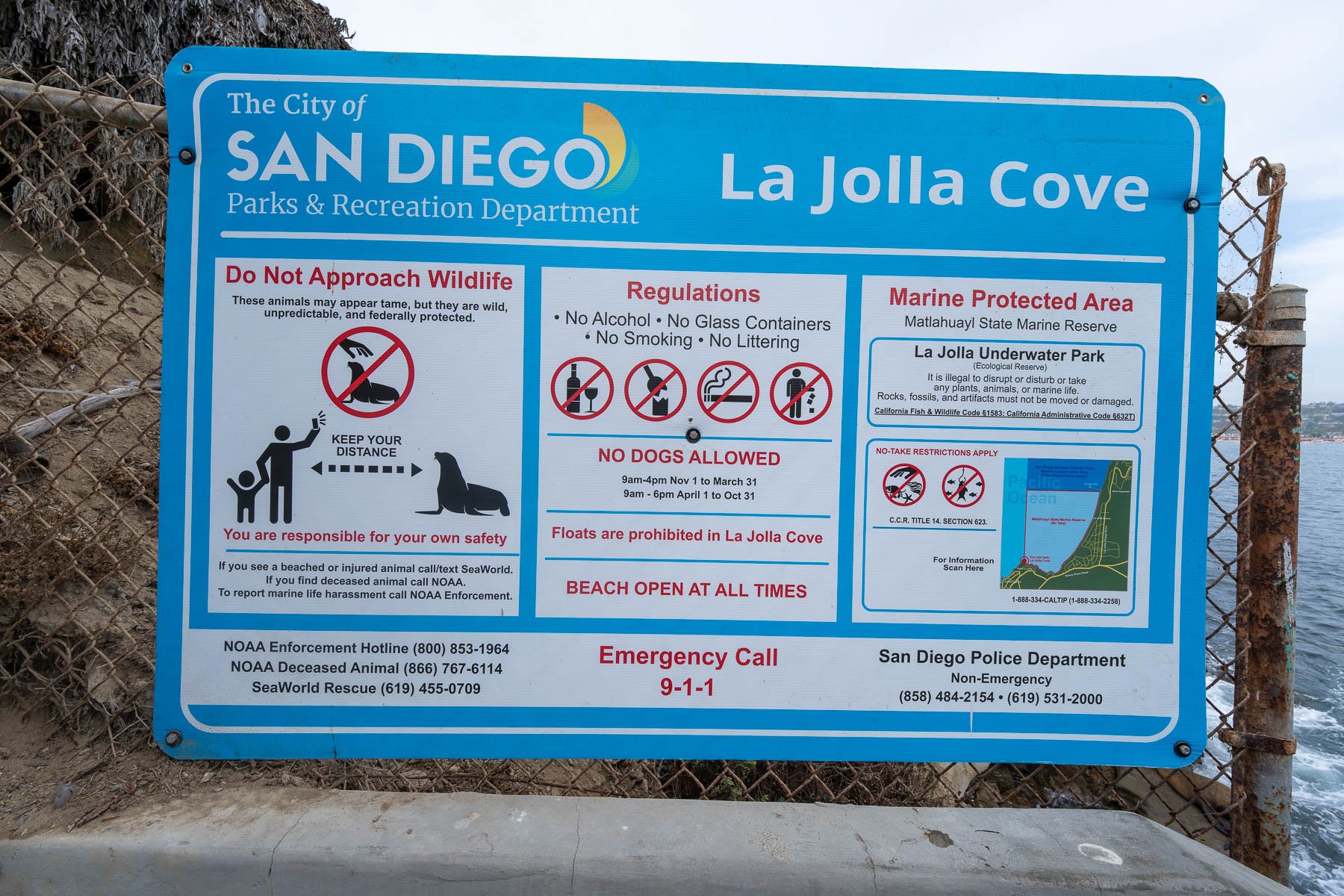
San Diego Parks & Recreation cautions visitors to La Jolla Cove not to approach the nearby California sea lions. The sign hangs at the end of the western beach access stairway.
» Originally published by Times of San Diego and La Jolla Village News on August 23, 2026.