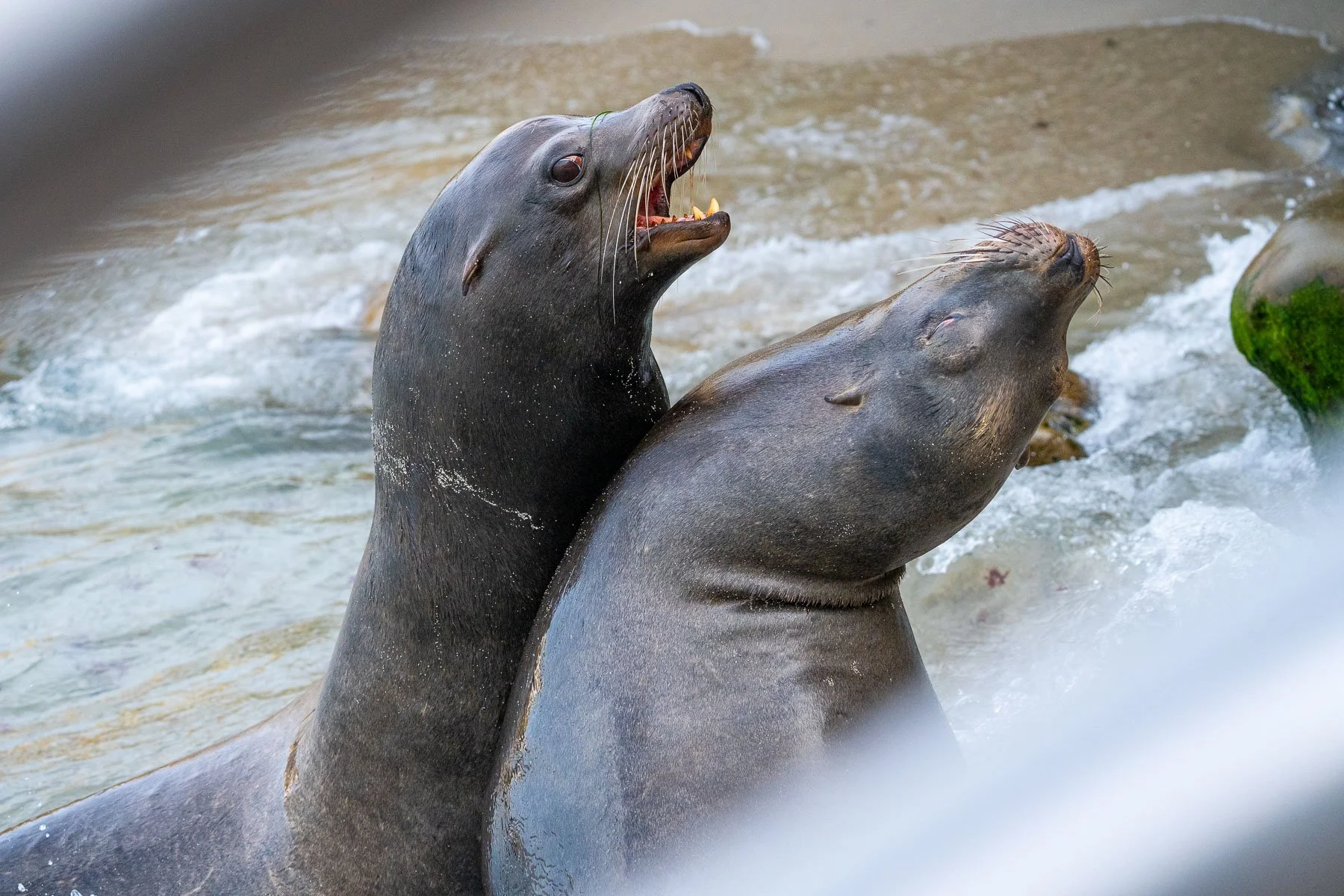
At La Jolla Cove, visitors stand just a few steps away from two California sea lions roughhousing as the tide rolls over the sand. “Please don’t fight!” screams a small child watching the duel between the metal railings of the beach access stairs.
Debate over public access at La Jolla Cove and the mistreatment of its resident sea lions boiled over when dozens of wildlife advocates and swimmers packed into a Sept. 10 La Jolla Town Council meeting to argue their differing visions for the Cove.
By the time the meeting began, 145 people had packed into a conference room at the La Valencia Hotel, far exceeding the 42 chairs that had been put out. Staff brought in more chairs, but many were still left standing.
The pro-closure crowd included Barrett Pall, a social media personality turned wildlife advocate who launched a pro-closure Change.org campaign in August. Pall called upon his supporters to attend the meeting and make their views known.
Pall’s petition surpassed 48,000 signatures before the meeting began.
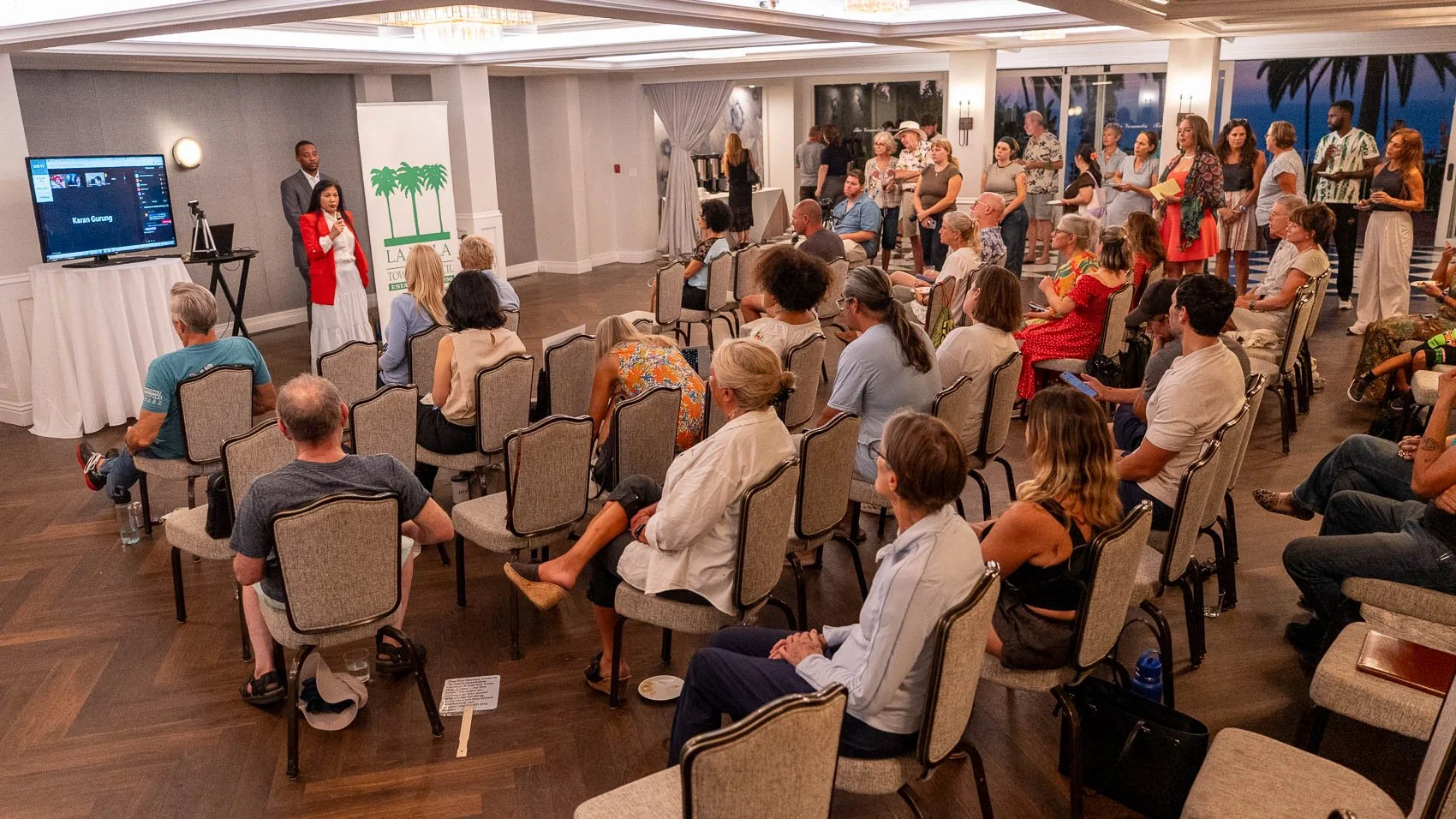
La Jolla Town Council president Mary Soriano addresses the audience at a Sept. 10 meeting.
“I want to thank you all for being here tonight,” town council president Mary Soriano said, after a 10-minute delay, addressing the crowded conference room with an echoing karaoke microphone and speaker.
Soriano laid out the ground rules: “Maintain respect for each other and orderly conduct.” She warned that San Diego police would escort out anyone who violated this rule.
As the crowd inside the hotel meeting room quieted down, chatter online grew contentious.
Within seconds of joining, participants were commenting “CLOSE THE COVE!!!!” and “PROTECT OUR WILDLIFE!!!!”
Others pushed back, arguing advocates were going too far.
One commenter compared closing the Cove to “shutting down the freeway because there are drunk drivers,” a reference to the viral video of 18-year-old La Jolla resident Tyler Muehl kicking a sea lion at Point La Jolla on July 22. The July incident turned ongoing wildlife harassment into a hot-button issue. Another commenter wondered whether advocates would close Crystal Pier to protect pigeons.
Some suggested that the sea lions could swim away from visitors. Advocates pointed out that, unlike pigeons, sea lions cannot simply fly away from human harassment. They argued that leaving the Cove isn’t an option for the sea lions because it is their home.
The meeting quickly devolved from the topic at hand.
Opponents questioned Pall’s financial ties to Change.org, where he serves as an ambassador. Supporters defended him, writing, “Change.org approached and offered to sponsor Barrett’s grassroots activism. Not the other way around. Activists don’t need to work for free and alone to be right in their values.”
Change.org says ambassadors earn $0.30 to $0.50 per signature, paid monthly as their petitions grow. Pall’s petition is estimated to earn $22,400 over its lifetime after passing 56,000 signatures on Sept. 13, though it continues to grow. Ambassadors also receive advanced payment based on audience size — Pall claims to reach over 2.3 million people across his social media platforms.
Pall declined to comment on the opposition’s payment concerns to Times of San Diego.

Moderators take back the karaoke microphone from Barrett Pall after he spoke past his allotted time.
Editor’s Note: Following publication of this article, Pall posted on social media stating he does not get paid per signature.
Those opposed to closing the Cove also challenged the statistics advocates used to support the proposal, most notably the Seal Society’s claim that 40% of sea lion pups have died this year at the La Jolla rookery.
Some commenters claimed the wildlife advocacy group has since retracted the pup mortality figure.
This is not the case, according to Robyn Davidoff, chair of Seal Society. Without official statistics from the agencies responsible for managing the Cove, Davidoff argued the Seal Society’s citizen science is the best measure available.
But the figure has faced public scrutiny. On the morning of the town council meeting, Scripps Institution of Oceanography graduate Zach Cabading argued that people should “follow sea lion science, not social media” in an op-ed by the website lajolla.ca. Cabading claims preliminary counts do not support a 40% mortality rate or establish that human harassment caused their deaths.
“I only just heard about this ‘rumor’ that someone said that the Sierra Club Seal Society is retracting their statement…This is not true,” Davidoff told Times of San Diego the day after the town hall.
“[Cabading] believes all research must be peer-reviewed and published. That just isn’t possible and would take years and funding,” Davidoff wrote.
“No entity is studying this sea lion population even though we have reached out to Scripps and the National Oceanic and Atmospheric Administration for years,” Davidoff wrote. “Our data is ‘Citizen Science’ backed by photos to document the pup deaths. We then discussed that pup mortality is much higher in the Cove than in the closed area around the corner at Point La Jolla.”
“The key point isn’t the exact mortality numbers but the fact that there is uncontrolled harassment of sea lions (pups and adults) in the La Jolla Cove daily,” Davidoff wrote.
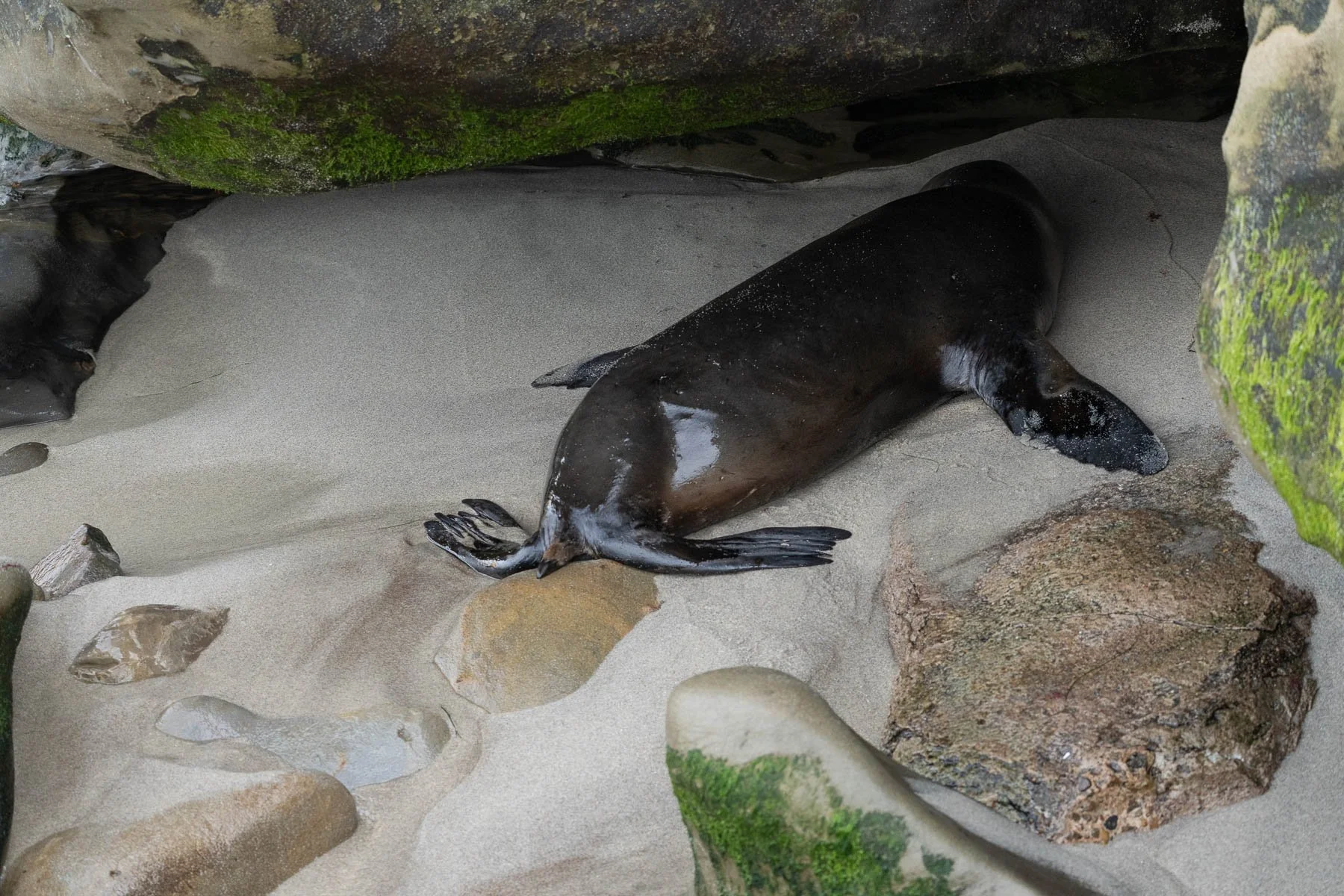
A young California sea lion attempts to hide from La Jolla Cove visitors in the shadow of the algae-covered sandstone cliffs that wall off the 140-foot beach.
The dispute over the numbers reflected a larger divide throughout the town council meeting: whether to keep people out of the Cove or force the city to better enforce protections agreed to in June.
Earlier in the day on Sept. 10, the issue came before the California Coastal Commission. San Diego commissioner Matt O’Malley reiterated his support for a partial closure.
O’Malley said swimmers should retain access to the water, but most visitors should be restricted to watching sea lions from above. Commission Vice Chair Dr. Caryl Hart recommended a sign-in system to record each person who enters the Cove.
“[The Cove] has always been cherished by the folks of San Diego, including myself,” O’Malley said. “Because the city has not been able to implement – for various reasons – the protocol it came up with, you’re seeing the abuse of the wildlife in that area, constantly.”
Council President LaCava’s representative at the meeting, Brian Elliot, said the discussion was moving towards the question of what access at the Cove should look like.
La Jolla Parks and Beaches, a local nonprofit and recognized advocate for La Jolla’s beaches, asked the city to explore opinions to limit access to those using the water, Elliot said while LaCava’s office has sought out other community groups for feedback.
Rather than calling for closure, the Seal Society is instead calling on the city to enforce the management plan it approved in June.
At the Coastal Commission meeting on Sept. 10, Seal Society representatives laid out the measures the city already approved to protect sea lions during pupping season. The plan called for rangers to patrol the beach, signs to warn visitors away from wildlife, and cones to keep people away from pups.
Instead, the group said, rangers have largely remained at the top of the stairs, signs have been poorly positioned and barriers are inconsistently enforced. The Seal Society has asked the city to fully implement the plan before limiting access to the Cove.
Back at the La Jolla Town Council meeting, public comment grew increasingly heated as advocates and swimmers took turns arguing their vision for the Cove.
Wildlife advocates argued that harassment and inadequate enforcement require stronger restrictions, while swimmers and other opponents questioned the evidence behind the pup mortality statistic, pointing to El Niño as the cause.
The debate spilled into personal accusations and interruptions, with the council struggling to maintain decorum. The La Jolla Town Council’s next step is to bring together the city and other agencies responsible for managing the Cove to discuss what public access should look like. A date for this meeting has not yet been determined.
“We have a few more minutes to do some karaoke, so if everybody wants to release with Closing La Jolla Cove: Wildlife advocates face off with swimmers, Town Council and Coastal Commission weigh ‘What access looks like’some of your favorite songs,” Soriano added, adjourning the meeting at 8:16 p.m. “You don’t have to be good, and we already have karaoke mics.”
» Originally published by Times of San Diego and La Jolla Village News on September 14, 2026.
The following text was not officially published, since it was cut for space. It is included here for posterity.
Back at the La Jolla Town Council meeting, public comment grew increasingly heated as advocates and swimmers took turns arguing their vision for the Cove.
A sea lion, portrayed by an anonymous activist, welcomed everyone to “karaoke night” through the microphone’s now painfully familiar echo effect. The suspiciously man-shaped sea lion said his family had lived at the Cove for generations, long before humans arrived.
“We would like to continue swimming here, living here; continuing our family traditions undisturbed by the invasive species called ‘humans,’” the sea lion said. “What the perpetually entitled human swimmers need to understand is that you’re all tourists. Water access cannot be enforced – there’s no money or people for it – so [the Cove] should be closed until you figure it out.”
Calls for decorum were near-constant throughout public comment.
Barrett Pall walked up to take the karaoke microphone with the crowd’s cheer at his back. Pall claimed that, despite public outcry, the city hasn’t acted "because of personal relationships with businesses and organizations that exploit the Cove for their own benefit.”
“People keep wanting to point the finger at tourists, but this is another distracting tactic that we know is only looking to misplace the blame for why this is a mess,” Pall said. “La Jolla as a town will not lose anything by closing off this beach, and we need to protect—”
“Time!” the moderator interjected. Another round of applause ushered Pall back to his seat.
Ben Ruth echoed Pall’s suggestion that financial interests are at play, telling the crowd that “it really makes me question the true motivations for keeping this place open, and who is making money off it.”
But as questions over money remain unanswered, the opposition offered a different explanation for this year’s high pup mortality: El Niño.
Chelsea Gods, a wildlife advocate, pointed to the Marine Mammal Protection Act as the reason sea lion populations had rebounded after decades of decline. She argued that continued inaction was unacceptable while animals were dying.
“We’re gonna laugh at sea animals dying?” Gods said. “Well, that sounds like La Jolla to me.”
“Decorum! Decorum!”
Elizabeth Grumet, a civil rights attorney and San Diegan native, said she grew up swimming in La Jolla Cove, even learning to swim there with her mother.
“I’ve heard the swimmers speak. At this point, I can’t swim in those waters and feel any peace of mind knowing that 40% of the pups — are dying during pupping season because of the harassment,” Grumet said. “Our swim isn’t more important than the lives of those sea lions.”
San Diego should look to Hawaii as an example, Grumet said, which requires visitors to Hanauma Bay Nature Preserve to apply for a permit days in advance if they want to swim alongside sea turtles.
Longtime swimmer and fisherman Kurt Koffman followed Grumet, blaming El Niño rather than human harassment for the recent deaths. He also questioned Pall’s qualifications, pointing to the money he has allegedly made promoting the issue on social media — calling out Pall for not being a native San Diegan.
“The mortality rates we’re seeing are because of El Niño, and that’s the issue that many of you are unaware of or not knowledgeable about,” Koffman said, the karaoke microphone’s echo becoming a shrill ringing. “The internet is not the place to learn about sea lions … learning about sea lions from an influencer who has made over $35,000, maybe $40,000, by publicizing this issue.”
“Decorum? Decorum!?” Pall interjected, but Koffman was done. He returned to his seat as the room jeered at him. This time, the crowd didn’t settle. Town council president Mary Soriano set aside the microphone, yelling to turn the audience’s attention towards the last in-person speaker.
Gia Borg then challenged Pall with his own words, reading from an August 21 Instagram video where he initially calls for compromise between swimmers and wildlife advocates.
“This is every word, you. ‘And there are definitely people in the water respecting animals and enjoying themselves, coexisting…However, it’s the people on the beach that seem to be the biggest problem and not respecting it. Overall, I think there’s some way to find a compromise,’” Borg quoted.
“And then, something changed in your post,” Borg said.
“Am I on trial?” Pall replied. The room was overtaken by incomprehensible yelling. President Soriano threatened to close down the meeting if people did not stop talking over the speakers.
“All of a sudden, it comes over the screen that there are 22,217 verified signatures,” Borg continued. “The landscape changes, your tone changes, there are signatures on a petition – and that’s questionable. This is you, ‘And the overall problem seems to be that people with a lot of money don’t have any care for others, including the animals.”
With in-person public comment complete, the conference room’s attention turned to a small television at the front of the room, where 45 online participants hoped to share their opinion.
“I want to thank you for holding yourself to decorum,” president Mary Soriano said. “If we have time, let’s do some karaoke tonight.”
Soriano barely finished speaking before decorum broke yet again.
“What the **** did you just say to me?!” Chelsea Gods yelled. “This woman just called me ‘ugly!’”
“And then you told me you hated my manicure!” the older, anti-closure woman replied, laughing.
The room immediately descended into an uproar. Activists demanded she be thrown out. President Mary Soriano directed San Diego police to escort the woman out of the room.
Attention turned once again to the online speakers, whose voices were nearly inaudible to the front rows while stuck coming from the small, quiet karaoke speaker. When their timers were up, the room offered polite applause.
“Thank you everyone. It’s tough when we have differing opinions, right? Very strong, differing opinions. The next step from here … Is to wait until the ladies in the back are done talking,” Soriano said, calling out people loudly talking at the back of the audience.
When the room finally settled, Soriano explained that the La Jolla Town Council’s next step would be to arrange a meeting with all of the agencies involved in the debate, including the city, the National Oceanic and Atmospheric Administration, park rangers and even SeaWorld.
After the meeting, Pall stayed behind to speak with supporters before stopping to speak with Times of San Diego. He said he was disappointed by what he described as “so much oppression” from people who claim to love the Cove.
“If we love it, we should take care of it. In my opinion, the only thing that will work at this point is to close the Cove, then figure out how to manage it because it’s not being managed right now.”
Borg interrupted as Pall spoke. Pall told her he did not want to start a conversation, describing their interaction during public comment as “really aggressive.”
“My words and opinions have changed the more that I’ve learned and continue to see how the Cove is being exploited by people that don’t actually care and want it for their own selfish needs,” Pall said.
Pall left the hotel shortly afterwards, and the meeting moved towards its unusual end.
“We have a few more minutes to do some karaoke, so if everybody wants to release with some of your favorite songs,” Soriano added, adjourning the meeting at 8:16 p.m. “You don’t have to be good, and we already have karaoke mics.”
Times of San Diego contributed to “Chiquitita” by ABBA, but everyone was too busy arguing to notice.